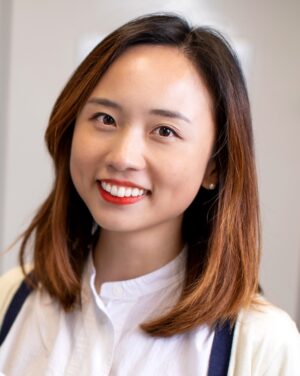
 H. Kay Chung\, Ph.D.[/caption]
[caption id="attachment_30551" align="alig
nnone" width="228"] H. Kay Chung\, Ph.D.[/caption]
Abstract:< /strong> My goal is to unleash the therapeutic potential of our own immune system via synthetic biology approach. Recently\, we have witnessed remark able progress in cancer treatment that employs adoptive cell transfer of tu mor-specific “killer” T cells. However\, tumors impede the infiltration\, s urvival\, and function of T cells\, rendering the beneficial effects of thi s approach transient. To address this hurdle\, I have been exploring T cell state programming. In the Susan Kaech laboratory at the Salk Institute\, I have identified transcription factors that enhance the memory and tumor-ki lling ability of T cells in an unbiased manner. I will discuss my multiomic s pipeline that predicts transcription factor activity as well as a multipl exed single-cell RNA sequencing approach that I have used for hit validatio n. I will also share how novel transcription factors\, Zscan20\, JDP2\, and Nfil3\, can be utilized for therapeutic purposes. In the second part of my talk\, I will discuss clinically applicable synthetic biology tools that I have developed during my Ph.D. training at Stanford University. They enabl e drug\, cell signal\, and light-dependent control of any protein for cell- /virus-based therapies. Leveraging these tools\, I will achieve an “ideal” T cell state. More specifically\, I will combinatorially and context-depend ently regulate master transcription factors so that they can toggle between T cell states best suited for fighting cancer cells at a given time in a g iven environment. My synthetic biology approaches not only enable effective T cell programming but also serve as a safety feature. In short\, my desig ner cell state differentiation strategy allows us to fully capitalize on th e therapeutic potential of our immune system for cancer and beyond.
< strong>Faculty Host: Sheila Stewart\, Ph.D.
CATEGORIES:Faculty Candidate Seminar,Invited External Speakers,Seminars / Lectures LOCATION:McDonnell Sciences Building\, 4th Floor\, Room 423 GEO:0.000000;0.000000 ORGANIZER;CN="Terese":MAILTO:tereseh@wustl.edu URL;VALUE=URI:https://calendar.med.wustl.edu/calendar/event/cell-biology-ph ysiology-seminar-series-66/ END:VEVENT BEGIN:VTIMEZONE TZID:America/Chicago BEGIN:DAYLIGHT TZOFFSETFROM:-0600 TZOFFSETTO:-0500 DTSTART:20230312T080000 TZNAME:CDT END:DAYLIGHT END:VTIMEZONE END:VCALENDAR