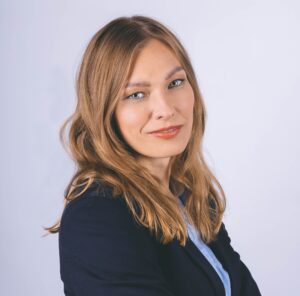
 Aldona Mzyk\, Ph.D.[/caption]
THIS IS A VIRTUAL SEMINAR ONLY.
Attendees can join via Zoom webinar link:
https://wustl.zoom
.us/j/91338325751?pwd=dGZWbG9CWWswOHkvSVI3dm01Rkc3QT09
Meeting ID:
913 383 257 51
Passcode: 006384
[caption id="attachment_30659"
align="alignnone" width="215"] Aldona Mzyk\, Ph.D.[/caption]
Sparkling\, hard and durable these are some of the pro perties commonly associated with diamonds. These qualities have made them d esirable within our society for a centuries. In research\, the unique prope rties of diamonds have drawn in many enthusiasts. Particularly\, nanodiamon ds with crystal lattice defects such as the negatively charged nitrogen-vac ancy (NV-) centers\, which have emerged as a powerful and versat ile quantum sensors for diverse quantities. This talk focuses on a specific way to use quantum-based sensing properties of nanodiamond with ensembles of NV- centers\, a technique called relaxometry (or T1). The key features of the NV− center are its optically detectable and con trollable spin states. In other words\, the NV- allows the conve rsion of magnetic noise into optical signals. Optical signals provide nanos cale resolution and unprecedented sensitivity as the detectability is far g reater than that of direct magnetic noise detection. Analogously to T1 meas urements in conventional magnetic resonance imaging (MRI)\, relaxometry all ows the detection of different concentrations of paramagnetic species. Howe ver\, relaxometry allows very local measurements\, the detected signals are from nanoscale voxels around the NV- center. Apart from detecti ng magnetic signals\, responsive coatings can be applied to modify surface of nanodiamonds\, which render T1 sensitive to other parameters as pH\, tem perature or electric fields.
Together with my colleagues from the UMC G in the Netherlands (group of prof. Romana Schirhagl) we were the first re searchers to apply relaxometry to understand the multiple functions of free radicals (FR) in cell biology. FRs are omnipresent and one of the key play ers in the ageing process on a molecular level. Despite their relevance\, i nformation about FRs is sparse and therefore their use as clinical biomarke rs is severely limited. Since FRs are short lived and reactive\, it is chal lenging to detect them with the state of the art methodology. So far\, I ha ve proved that the nanodiamonds and T1 relaxometry technique could be used for the real-time monitoring of changes in the concentration of free radica ls at the level of single human cells\, yeasts and bacterial biofilm. In my talk I will address a few exciting examples of biological processes and th eir clinical relevance where the role of free radicals was explored with T1 relaxometry. In one of the projects\, I have been investigating FRs genera tion in samples from arthritis patients. Arthritis is a common disease whic h is characterized by a decline of cartilage in joints. It can lead to disa bilities and a diminished quality of life. The two most common types of art hritis are osteoarthritis (OA) where cartilage damage occurs in degenerativ e diseases and rheumatoid arthritis (RA) where the decline occurs during ch ronic inflammation of joints. I have found significant differences in the l evel of free radicals in RA and OA synovial fluids and derived cells. The p roof-of-concept experiment has also shown that nanodiamond magnetometry ena bles real-time efficiency monitoring of anti-inflammatory therapeutics. Apa rt from the arthritis research\, I have shown there is great potential in u sing nanodiamond magnetometry to investigate a free radical-based theory fo r male infertility. Herein\, the unknown factor was the source of radicals that play a role in the sperm maturation process. The nanodiamond magnetome try allowed me to identify the prominent source of radical generation in sp erm maturation and shed light on a role of progesterone.
Finally\, wi th this talk I would like to stimulate discourse on the future of T1 relaxo metry. I will give you insight into my further research ambitions and how t hese will open a new perspective for using nanodiamond-based quantum sensin g to explore unknown aspects of oxidative stress in mechanobiology. This is especially important for the design of next generation biomaterials and dr ug delivery systems for modulation of immune responses in various organs. CATEGORIES:Faculty Candidate Seminar,Invited External Speakers,Seminars / Lectures ORGANIZER;CN="Terese":MAILTO:tereseh@wustl.edu URL;VALUE=URI:https://calendar.med.wustl.edu/calendar/event/cell-biology-ph ysiology-seminar-series-virtual/ END:VEVENT BEGIN:VTIMEZONE TZID:America/Chicago BEGIN:STANDARD TZOFFSETFROM:-0500 TZOFFSETTO:-0600 DTSTART:20221106T070000 TZNAME:CST END:STANDARD END:VTIMEZONE END:VCALENDAR